Date: 28 Oct, 2026
Location: Sharjah - UAE
H.E. Dr. Obaid Saif Hamad Al Zaabi, Chairman of the Board of the Arab Authority for Agricultural Investment and Development (AAAID), has underscored the importance of directing agricultural investment towards higher productivity, more efficient resource use and the development of agricultural and food value chains to strengthen food security and generate sustainable economic returns over the long term.
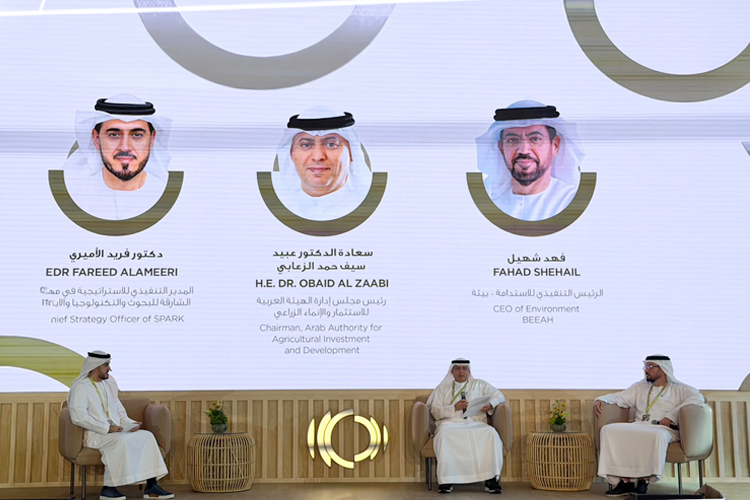
Dr. Al Zaabi made these remarks during the first dialogue session, “Sharjah Towards the Future: Building the Next Decade of Sustainability,” at Sharjah Next: Sustainability 2026, held at the Sharjah Research, Technology and Innovation Park (SRTIP) under the patronage and in the presence of His Highness Sheikh Dr. Sultan bin Muhammad Al Qasimi, Supreme Council Member and Ruler of Sharjah. The session also featured Mr. Fahad Ali Shehail, CEO – Sustainability at BEEAH, and was moderated by Dr. Fareed Mahmoud Alameeri, Chief Strategy Officer at SRTIP.
H.E. Dr. Al Zaabi noted that strengthening food security across the Arab region requires investment in projects that deliver higher productivity with fewer resources, alongside the development of higher-value activities across agricultural and food value chains. These include storage, food processing, cold-chain infrastructure and measures to reduce food loss. He also highlighted the importance of linking financing with access to agricultural inputs, technical supervision and reliable markets to improve project performance and long-term viability.
He further emphasised that turning agricultural innovation into scalable investment opportunities requires solutions to address demonstrable market needs, deliver evidence of their effectiveness through field application, and be supported by viable business models and capable operating teams. Solutions must also be adaptable to the conditions prevalent across the Arab region, including water scarcity, high temperatures and soil salinity. Combining financial viability with measurable development impact, he noted, is essential to attracting private investment.
On financing innovation, Dr. Al Zaabi highlighted the need for financing instruments tailored to the different stages of project development, particularly the transition from research and development to commercial application and scale-up. Such instruments may include co-investment, guarantees, insurance, blended finance and Islamic finance. These mechanisms can help distribute risk among stakeholders, address financing gaps and strengthen promising projects’ ability to attract private-sector investment.
He also stressed the importance of partnerships among governments, universities, research institutions, the private sector, financial institutions and development finance institutions in building an integrated investment ecosystem that supports innovation and sustainability. Coordinated action across these stakeholders—including the development of enabling regulatory frameworks and incentives, the testing of technological solutions, the translation of research into commercially viable products and services, and the deployment of appropriate financing instruments—can help create an environment in which innovation is more effectively translated into sustainable investment projects.
Dr. Al Zaabi concluded by underscoring the need to move beyond partnerships centred on individual projects towards sustained investment platforms that bring together investment-ready projects and apply clear, consistent standards for project preparation, appraisal and impact measurement. This approach should include tracking the tangible results of investments in terms of food production, job creation and resource-use efficiency, thereby supporting more sustainable food systems and strengthening food security across the Arab region.
AAAID’s participation reflects its role in promoting investment in food security across Arab countries by developing investment projects, strengthening partnerships with development institutions and the private sector, and mobilising capital towards initiatives that combine financial viability with development impact. These efforts support more sustainable food systems and more efficient use of resources.
Sharjah Next: Sustainability 2026 brings together representatives of government entities, research institutions, investors and business leaders to explore innovative solutions and accelerate the translation of research and technological advances into practical applications and sustainable economic opportunities.



