Date: 11 Sep, 2026
Location: Dubai - UAE
H.E. Dr. Obaid Saif Hamad Al Zaabi, Chairman of the Board of the Arab Authority for Agricultural Investment and Development (AAAID), has underscored the need for the Arab region to move beyond a narrow focus on increasing food production and instead prioritize more efficient investment, greater development impact and more resilient food systems.
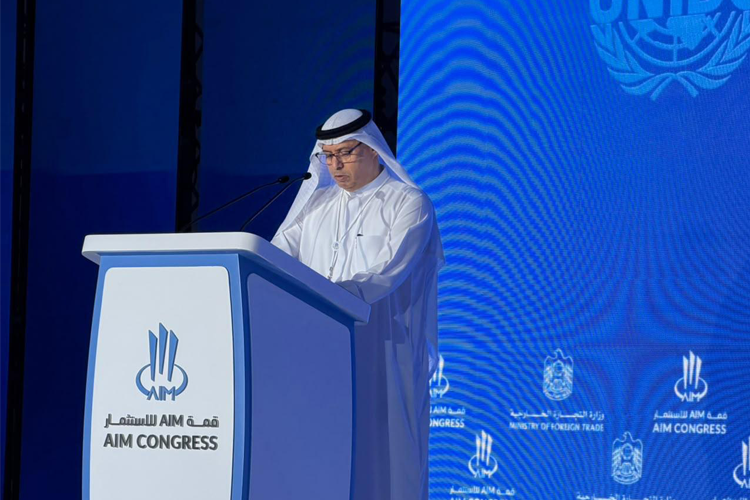
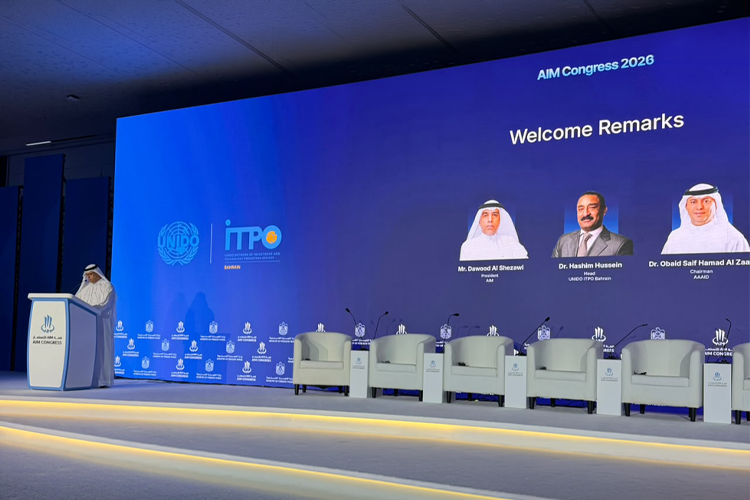
Speaking as a keynote speaker at the Quad Economy Futures Forum, held on the sidelines of AIM Congress 2026 in Dubai, Dr. Al Zaabi said the region must build food systems that are better equipped to withstand climate shocks, water scarcity and supply-chain disruptions.
The Forum was organized by the United Nations Industrial Development Organization Investment and Technology Promotion Office in Bahrain (UNIDO ITPO Bahrain), in partnership with AIM Congress, under the patronage of His Highness Sheikh Mohammed bin Rashid Al Maktoum, Vice President and Prime Minister of the United Arab Emirates and Ruler of Dubai.
The event brought together senior government officials, representatives of international organizations, investors, business leaders and experts for a high-level dialogue on the potential of the Blue, Green, Orange and Silver Economies to drive investment and entrepreneurship, foster innovation and inclusive growth, create jobs, and strengthen economic resilience and sustainable development.
In his opening remarks, H.E. Dr. Al Zaabi highlighted some of the pressing food-security challenges facing the Arab region. He noted that around 77.5 million people face food shortages, while four in ten people experience moderate or severe food insecurity. Agriculture, meanwhile, accounts for nearly 85 percent of available water resources, while the Arab food gap is estimated at approximately US$49.5 billion.
“The challenge is no longer simply how to produce more food, but how to invest better — with greater efficiency, broader development impact and real resilience to climate shocks, water scarcity and supply-chain disruptions,” Dr. Al Zaabi said.
He stressed that the Authority views the integration of economic and production systems as a key driver of both investment returns and development impact.
Recent evidence, he noted, indicates that ambitious circular-economy strategies can generate measurable economic and employment gains while reducing emissions. Integrated agricultural systems can also improve water-use efficiency and increase productivity by addressing soil health, water management and agricultural productivity as interconnected priorities.
H.E. Dr. Al Zaabi explained that the Quad Economy framework translates, from the Authority’s perspective, into four interconnected investment pathways: the Green, Blue, Orange and Silver Economies.
These pathways include improving resource efficiency and integrating sustainability considerations across production and processing assets; expanding aquaculture and higher-value marine value chains; unlocking the commercial potential of Arab food heritage through branding, provenance and value creation; and developing food products and solutions focused on nutrition and health.
He also highlighted the Authority’s role in advancing agricultural investment and food security across the Arab region. MAYR’s direct investment portfolio currently comprises approximately 45 companies, with total investments of around US$664 million.
According to H.E. Dr. Al Zaabi, these investments support the livelihoods of approximately 107,000 permanent and seasonal workers, including more than 4,000 women engaged in food production and processing activities.
He emphasized that the Authority measures success not only in terms of financial returns, but also through its contribution to food security, employment, community development and the sustainable management of natural resources.
“Sustainability is not a trade-off against profitability. It is a fundamental part of building investments that are more resilient, more durable and better able to create long-term value,” he said.
H.E. Dr. Al Zaabi also called for stronger long-term partnerships that combine capital, technical expertise and implementation capacity.
He noted that the Authority’s internal assessments indicate that every US$1 invested by AAAID can help mobilize an additional US$6–7 from partners, including governments, the private sector and multilateral development and financial institutions.
Concluding his remarks, H.E. Dr. Al Zaabi said that, after five decades of operation, the Authority is entering a new phase — moving beyond the financing of individual projects towards the development of integrated investment ecosystems.
This approach, he said, aims to strengthen the Authority’s role as an Arab platform for catalysing investment in food security, while generating sustainable economic and development impact.
“We do not invest only in projects. We invest in people, in resources and in the stability of the economies that our children will inherit,” Dr. Al Zaabi concluded.