Date: 29 Oct, 2026
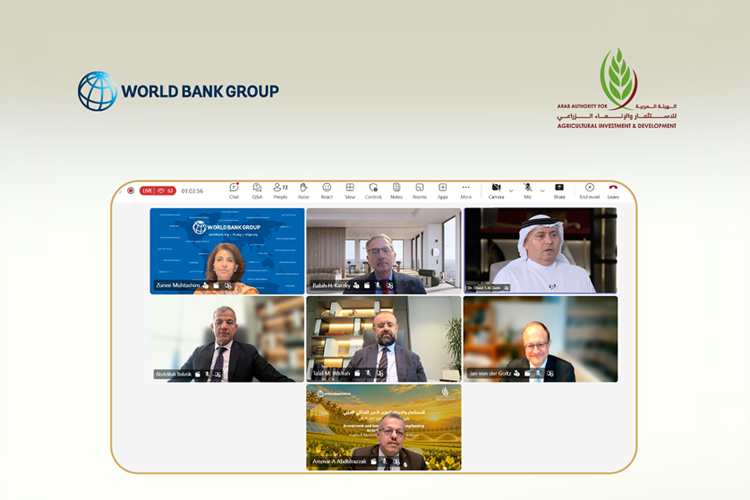
The Arab Authority for Agricultural Investment and Development (AAAID), in collaboration with the World Bank Group, held a virtual workshop titled “Investment and Innovation for Strengthening Arab Food Security: Insights and Opportunities from the World Bank Report.” The workshop brought together experts from the World Bank and the International Finance Corporation (IFC) to explore investment opportunities across agrifood systems and discuss how innovation, technology, and greater private sector participation can help strengthen food security and create jobs.
H.E. Dr. Obaid Saif Hamad Al Zaabi, Chairman of the Board of AAAID, emphasized the importance of increasing investment in the Arab agrifood sector and harnessing innovation and modern technologies to develop more efficient and sustainable agrifood systems. He highlighted the need to move beyond institutional dialogue and knowledge exchange toward practical partnerships that can translate into jointly developed and implemented investment projects. Such partnerships, he noted, could build on AAAID’s nearly 50 years of experience in the Arab region and its understanding of local markets and community needs, while leveraging the financing and technical expertise of the World Bank Group and IFC. This complementary approach can help advance investment opportunities that contribute to food security and sustainable development across the Arab region.
The workshop featured a keynote address by Dr. Rabih Karaky, Regional Practice Manager for Agriculture and Food in the World Bank’s Middle East, North Africa, Afghanistan and Pakistan (MENAAP) Region. He discussed key findings and policy priorities from the World Bank’s June 2026 regional report, Building Food Security, Creating Jobs: Policy Pathways for the Region. The report examines policy pathways and investment priorities to strengthen food and nutrition security, transform agrifood systems, and expand employment opportunities across the region. It also highlights the role of regional trade and countries’ comparative advantages in improving food security and strengthening the resilience of food supply systems.
The workshop included two technical presentations. The first, delivered by Jan von der Goltz, Senior Economist at the World Bank, examined food security challenges and opportunities to strengthen domestic food production across the MENAAP region. The second, delivered by Zunee Muhtashim, Principal Investment Officer at IFC in Karachi, Pakistan, explored the role of AgriConnect, a World Bank Group initiative, in mobilizing investment, strengthening private sector engagement, and supporting the transformation of agrifood systems to improve food security and create jobs.
Discussions focused on the role of innovation and technology in raising productivity and improving resource-use efficiency, particularly water use. Participants also examined opportunities to strengthen agrifood value chains, improve storage, logistics and trade, and expand private sector investment. Financing mechanisms and risk-mitigation instruments were discussed as important means of translating promising opportunities into bankable and implementable investment projects, while balancing commercial viability with development impact.
The workshop provided a platform for exchanging knowledge and perspectives on how the report’s findings could inform investment priorities, address constraints to project development and scale-up, and strengthen collaboration among development finance institutions, research organizations, and the private sector. Participants also explored opportunities for joint project development, technical and institutional capacity building, and stronger links between investment, producers, farmers, and local market needs.
Participants included representatives of the African Development Bank, the International Islamic Trade Finance Corporation (ITFC), and the Food and Agriculture Organization of the United Nations (FAO), as well as representatives from United Arab Emirates University, the University of Khartoum, the University of Baghdad, the Desert Research Center, and agricultural research institutions. The workshop also brought together chief executives, general managers, and specialists in investment and food security.
The workshop forms part of AAAID’s broader efforts to strengthen cooperation with international financial and development institutions and draw on specialized knowledge and economic analysis to inform its investment priorities. Through these partnerships, AAAID aims to identify and develop investment opportunities across food security-related sectors, support more efficient and sustainable agrifood systems, and strengthen the contribution of investment to food security and job creation across the Arab region.



